

BUSINESS PROCESS AUTOMATION
Business process automation with rules your team can understand.
Coordinate requests, approvals and tasks across people and applications. Repeated steps follow agreed conditions, while exceptions reach an accountable person with the context needed to decide what happens next.
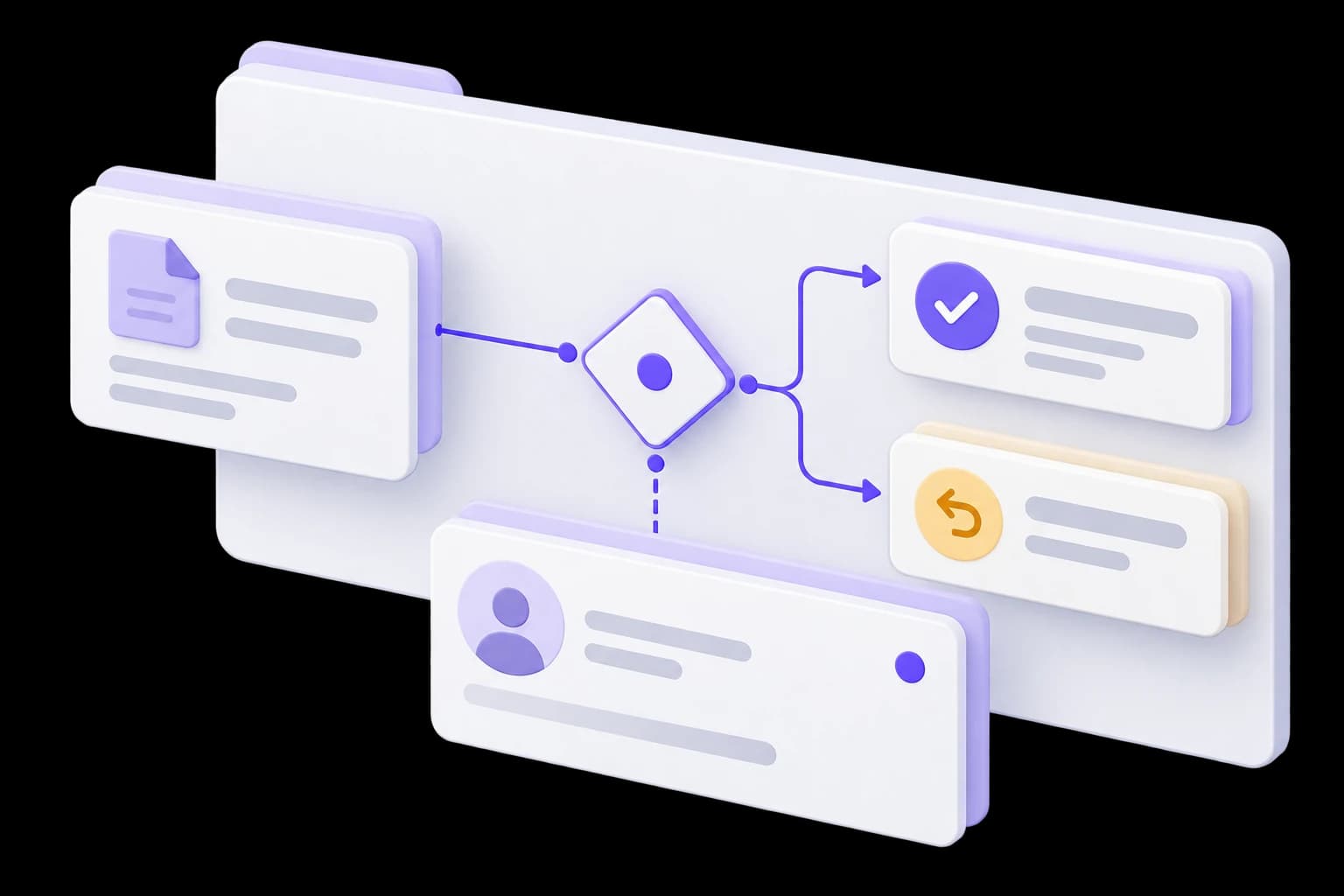
Change a condition. See the route.
A purchase request illustrates when one approval is enough, when another participant is required and what happens when information is missing.
Demonstration data. This example does not change records or send requests.
Example rule: up to and including UAH 10,000 requires the manager; above UAH 10,000 requires the manager and finance. A missing supplier requires clarification.
Request amount
Supplier provided
DEMO-PO-008 · 5,000 UAH
Route
- Request
- Manager
- Ready to proceed after approvals
Reason
The route requires the manager’s decision. This is a preview; no approval has occurred.
Which workflows are worth automating?
Approvals need constant chasing.
Someone manually finds the next participant and checks whose turn it is.
Similar requests receive different treatment.
The rules live in individual employees’ knowledge rather than in the system.
Work stalls at handoff.
One department has finished, but the next has not received the task.
What can be automated
- Intake and routing.Assign requests by type, department, priority or accountable owner.
- Approvals.Sequential and parallel decisions with explicit transition and return rules.
- Task creation.Prepare the next action and its context when an agreed event occurs.
- Reminders and escalation.Notify the right people about waiting and overdue work.
- Actions across systems.Transfer records and trigger operations through available integrations.
- Execution history.Show who acted, when and under which rule.


Exceptions need a route too
Information may be missing, ownership may change or an external application may be unavailable. We define waiting states, retries and human handoff for these situations. Staff can see why work stopped and resume it after resolving the cause.
Portfolio example

Automation platform and workflow management
Multi-step orchestration, accountable assignments and a shared control interface. This project brings workflows and integrations together in an operational platform.
View case studyFrom a rule to a verified workflow
01. Choose the workflow
Define its trigger, participants, expected outcome and current delays.
A map of the first workflow.02. Agree the rules
Specify conditions, deadlines, approvals and exceptions.
Agreed routes and decision rules.03. Evaluate examples
Walk through normal, incomplete and invalid requests.
A verified scenario set.04. Connect execution
Implement actions, integrations, logs and duplicate controls.
A working workflow with activity history.05. Pilot and refine
Start with a limited workload and review behaviour with the team.
A pilot and improvement list.


ESTIMATE
Start with a repeated workflow
Bring sample requests, the participants and decision rules. If those rules are not documented, we can separate repeatable steps from situations that require human judgement.
Discuss automationQUESTIONS & ANSWERS
Automation questions
Short answers before we discuss your project.

Questions and answers
NEXT STEP
Let the next stepfollow an agreed rule.
Show us a repeated workflow. We will define the conditions, owners and first automation scenario.